JournalChemical-free colour
Ammonia allergy: is organic hair dye safe?

In this guide · 6 sections
- 01What ammonia actually does to your scalp
- 02What “organic” really means on a hair dye
- 03Real alternatives if you want colour without the risk
- 04How to do a patch test properly before every application
- 05When to see a doctor before dyeing again
- 06Colour without fear is possible if you know what to look for
It can be, but only if the product contains no ammonia, no PPD and no other skin sensitisers. The word “organic” on its own guarantees none of those three things. Here is what to look for on the label, which plant-based alternatives are genuinely safe, and how to do a patch test properly.
In short
Is organic hair dye safe if you are allergic to ammonia?
It can be, but only if the formula contains no ammonia, PPD or other sensitisers: the word “organic” does not guarantee it. Besides, many reactions blamed on ammonia are actually caused by PPD. Plant-based hair muds contain neither ammonia nor PPD, and before applying them we look at your scalp and, if needed, do a sensitivity test.
Many of the reactions blamed on ammonia actually come from other ingredients, above all paraphenylenediamine (PPD), the most common sensitiser in hair dyes. In this guide you will find what to watch for on the INCI list, which plant-based alternatives are genuinely safe, how to do a patch test step by step and when it is time to see a specialist. At Mi Momento, an organic hair salon in Gràcia (Barcelona), we work with hair muds and certified organic cosmetics precisely because we know that “natural” does not mean “safe for reactive skin”.
What ammonia actually does to your scalp
Ammonia is an alkaliser: it opens the hair cuticle so the colourant can get inside the fibre. Along the way it can irritate the scalp, the eyes and the airways, by contact or through its fumes, but that reaction is chemical, not allergic.
Irritation and allergy are not the same thing
Irritation appears during the application or right after, where the product touched the skin, and goes away once you remove it. An allergy is different: the immune system recognises an ingredient and reacts, sometimes hours or days later, and more strongly each time. There are no reliable figures for true ammonia allergy; for PPD there are.
Watch out for the substitutes: ethanolamine (MEA) and aminomethyl propanol appear in many “ammonia-free” dyes and are not necessarily gentler. A dye without ammonia is not a dye without alkalisers, and those can irritate just as much or more.
Why PPD is the usual suspect
In a study of 2,939 patients from twelve dermatology clinics who were patch tested with hair dye components, 4.5% tested positive to PPD, as reported in the review “Cosméticos capilares: tintes” in Actas Dermo-Sifiliográficas. There is no equivalent figure for ammonia. And a negative PPD result does not rule out a reaction to other oxidative colourants, such as toluene-2,5-diamine (PTD), aminophenols or resorcinol, nor to the persulfates in bleaching products.
Types of reaction that can appear
The most common is allergic contact dermatitis, which appears between hours and several days after dyeing: intense itching, redness, burning, flaking or blisters on the scalp, the hairline, the ears or the neck. Irritant dermatitis is felt during the application or shortly after, and is mostly linked to ammonia and peroxide. The persulfates in bleaching products can cause immediate reactions: rhinitis, asthma, contact urticaria and, in exceptional cases, anaphylaxis.
Facial swelling, difficulty breathing or dizziness need urgent medical attention, not an appointment.
What “organic” really means on a hair dye
“Organic” is not a regulated term in cosmetics the way it is in food. A dye can include a few botanical extracts and call itself organic while still containing ammonia, PPD or peroxide. The only reliable way to know is to read the full INCI list, not the front of the box.
Ingredients to look for on the INCI list
Look for these names before using any dye, whatever it calls itself:
- Ammonia: ammonium hydroxide.
- Ammonia substitutes: ethanolamine or monoethanolamine (MEA) and aminomethyl propanol.
- Oxidant: hydrogen peroxide.
- Sensitising colourants: p-phenylenediamine (PPD) and toluene-2,5-diamine sulfate (PTD).
- Added irritants: resorcinol and sodium picramate.
- Fragrances and essential oils: even plant-derived ones, such as lavender or ylang-ylang, can sensitise, as a review in the International Journal of Women's Dermatology reports. “Natural” does not mean “non-allergenic”.
Which certifications do offer guarantees, and how far they go
The seals recognised in Europe, such as Ecocert's COSMOS Organic or NATRUE, demand verifiable requirements, not a marketing claim. But none of them guarantees in general that a specific product is free of PPD and ammonia: it depends on the rules of each category and on the formula.
A genuinely certified product states exactly what it contains and what it excludes. If the packaging does not say “PPD-free” and “ammonia-free”, do not assume it, even with the seal.
Hair muds at Mi Momento
Want to try it on your hair?
Hair muds: plant-based colour that glazes grey hair and cares for the scalp.
- Price
- from €120
- Duration
- 90 min
- Where
- Carrer de Verdi 49, Gràcia
Hair muds: plant-based colour that glazes grey hair and cares for the scalp.
- Price
- from €120
- Duration
- 90 min
- Where
- Carrer de Verdi 49, Gràcia
Real alternatives if you want colour without the risk
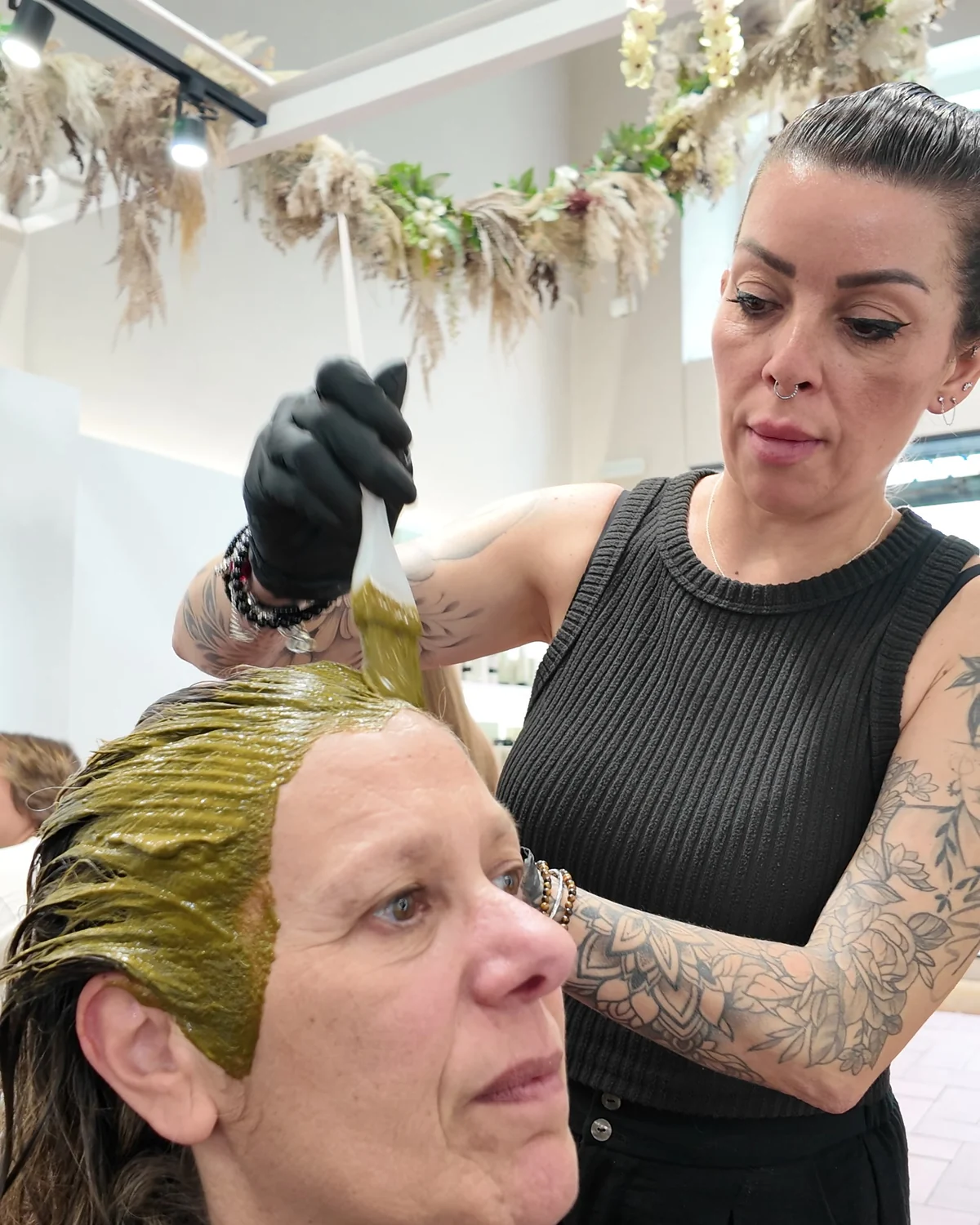
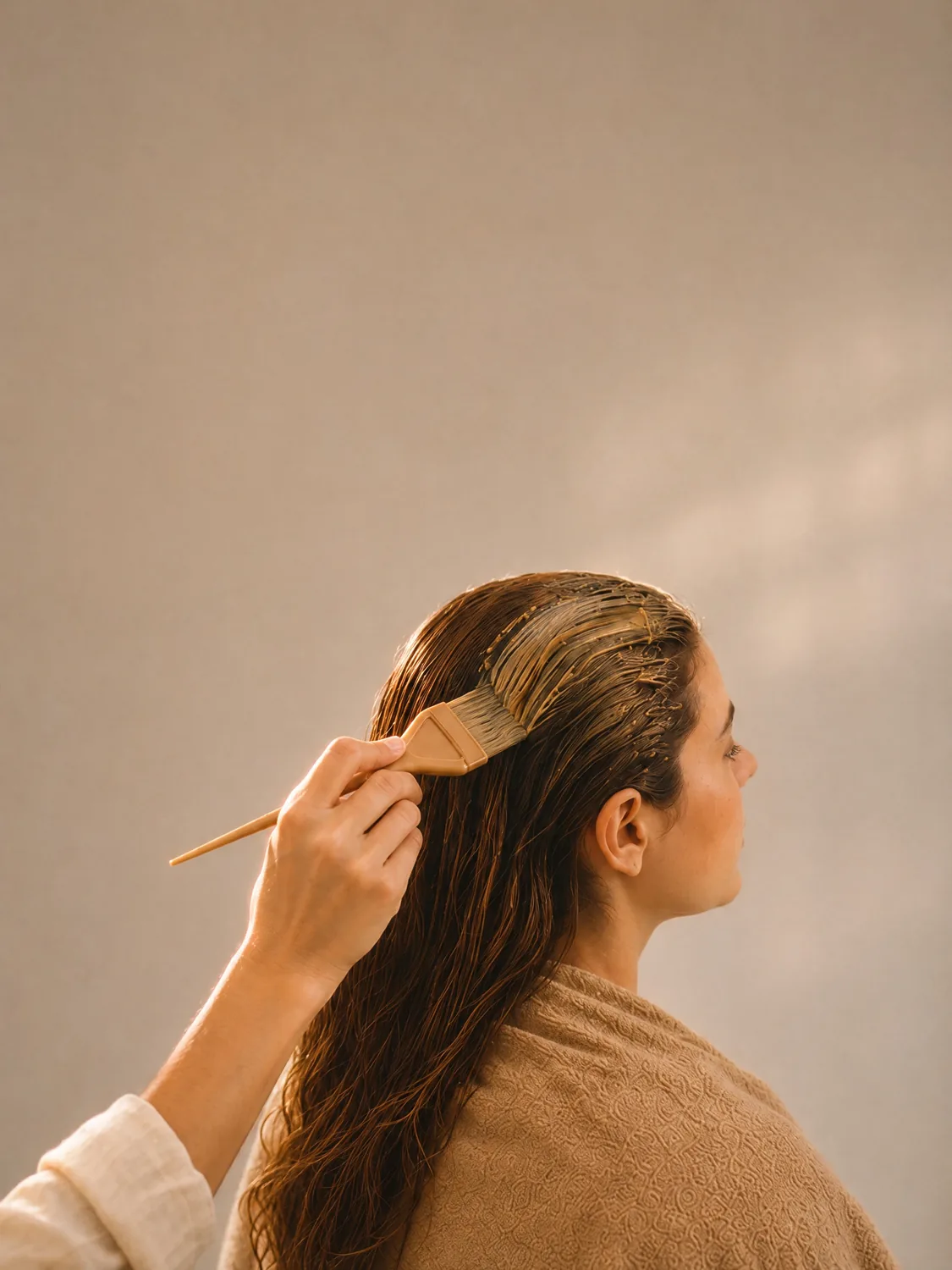
Hair muds are plant-based colour: ground dye plants such as henna (Lawsonia), indigo, cassia or walnut, mixed with clays, minerals and hot water. They contain no ammonia or peroxide, and ours contain no PPD or synthetic sensitisers either. If you buy them elsewhere, check the INCI list: a very dark, black mud usually carries the same chemistry as a dye.
With grey hair they do something different from a dye: they do not cover it, they glaze it and blend it into your colour, like highlights. And they do not lighten. Touch-ups come roughly every six weeks, and since there is no hard root line you will not be counting the days between sessions.
| Type of colour | How long it lasts | And grey hair | Lightens | PPD risk |
|---|---|---|---|---|
| Hair muds (dye plants) | Touch-up every 6 weeks, no hard root line | Does not cover it: glazes and blends it | No | None in ours; elsewhere, check the list |
| Permanent oxidative dye | 6-8 weeks | Yes, immediate coverage | Yes | High if it contains PPD or PTD |
| Semi-permanent dye | 4-6 weeks | Partial | No | Variable: check the formula |
| Temporary colour | 1-3 washes | Only tones | No | Low, but check the fragrances |
Indicative durations: they depend on hair porosity, the percentage of grey and home care.
Beware of black henna
There is one critical point: so-called black henna can contain high, undeclared concentrations of PPD and cause severe dermatitis, blisters or scarring. If you have reactive skin, avoid it completely. True henna, Lawsonia, gives a reddish or copper tone; never black.
Semi-permanents, PPD-free dyes and temporary colour
Semi-permanent dyes usually do without ammonia, but not always without PPD: the whole formula needs checking. “PPD-free” dyes may contain PTD or other oxidative colourants with cross-reactivity, which sensitise in a similar way. Temporary colour, as a spray or pigmented mask, has the lowest exposure because it needs no oxidation, although it may contain sensitising fragrances or preservatives.
No alternative removes the risk entirely without checking the full formula and doing the patch test first.
Why a specialised salon changes the outcome
At Mi Momento (Carrer de Verdi 49, Gràcia) we work with hair muds and certified organic cosmetics. They are the choice of clients who have spent years reacting to dye and want to keep their colour without punishing their scalp. Before preparing your blend we go through your history and look at your hair and scalp with the micro-camera, with you right there, because there is no single recipe: every skin responds in its own way.
If it is your first time with plants and your blend contains indigo, we do a sensitivity test on your arm before applying it. That care is exactly the difference between a “natural” marketing product and a formula that is safe for sensitive skin. With 4.8 out of 5 on Google and 586 reviews, it is also what people who come to us appreciate most.
How to do a patch test properly before every application
Do it at least 48 hours before every application, even if you have used the same product before. Without skipping a step:
Mix the dye exactly as you will use it
Colourant and developer in the stated proportions. Testing only part of the product does not reproduce the real reaction.
Wash and dry a small area of healthy skin
Behind the ear or on the inside of the elbow.
Apply a small amount
The size of a coin, with a cotton bud, and let it air dry. Do not cover or rub it.
Check at 30 minutes and at 48 hours
Keep the area dry and do not touch it in the meantime.
No reaction? Go ahead
Following the product's instructions.
Do not test on irritated, broken or sunburnt skin. A negative test reduces the risk, but does not remove it, especially if your skin has reacted before.
Signs that mean you must stop
A positive result is any of these signs on the test area: redness, itching, burning, swelling, rash or blisters. If any appears, rinse the product off with plenty of water and do not dye your hair. And if during the test or during the dyeing you notice facial swelling, difficulty breathing or dizziness, seek urgent medical attention without waiting to see if it passes.
When to see a doctor before dyeing again
You need a dermatologist to see you before using any dye again if you have had itching, burning, blisters, swelling or flaking after a previous application, even a mild one. Also if you have active eczema or an inflamed scalp, a history of reaction to PPD, fragrances, preservatives or persulfates, or breathing symptoms during or after dyeing.
Any reaction with swelling of the lips, tongue or face, difficulty breathing, dizziness or trouble swallowing is an emergency, not a scheduled appointment.
What tests the specialist may ask for
The patch test is the one that confirms allergic contact dermatitis: the dermatologist or allergist applies the suspect ingredients to your back and reads the result a few days later. It can include your dye and its components separately to find the exact culprit. Blood tests and prick tests are reserved for immediate reactions and are no use for most contact allergies to dyes.
The sensitivity test on the box is a useful precaution, but it neither replaces a medical assessment nor identifies the ingredient. Always take the packaging with the full INCI list: standard fragrance tests may not pick up every essential oil in a plant dye.
Colour without fear is possible if you know what to look for
Whether an organic dye is safe with an ammonia allergy depends, in the end, on what it really contains. For reactive skin, hair muds and genuinely certified plant dyes are the alternative to consider, always with a patch test first, the INCI list read, and someone in front of you who can tell a marketing claim from a safe formula.
That is what we aim for at Mi Momento: that you leave with your scalp in better shape than it came in. It is not just about switching dye, but about choosing a way of caring for your hair that respects your skin in the long run.
If you are in Barcelona and want advice on organic colour for sensitive skin, book your consultation at the salon in Gràcia or write to us. We go through your history and your scalp and find, with you, the formula that suits your skin, not the other way round.
Chemical-free colour
Frequently asked questions
How far in advance should I do the patch test before dyeing?
At least 48 hours before every application. Mix the dye exactly as you will use it, apply it to a clean area behind the ear or in the crook of the elbow and check it at 30 minutes and at 48 hours. A negative test reduces the risk, but does not remove it entirely.
Can I use black henna if I have reactive skin?
No. Black henna can contain high, undeclared concentrations of PPD and cause severe dermatitis, blisters or scarring. True henna, Lawsonia, gives a reddish or copper tone, never black.
Are semi-permanent dyes safe if I avoid PPD and ammonia?
They can be, but not always. Many do without ammonia and still contain PPD or cross-reactive substitutes. Confirm on the INCI list that there is no PPD, PTD or oxidants, and do the patch test first.
What should I take to the consultation if I have reacted to a dye?
The packaging with the full INCI list. The patch test can include the dye and its components separately, and having the list helps the dermatologist or allergist identify the exact culprit.
Keep reading
Our services
Colour without chemicals, at the salon
Would you rather we looked at your hair?
Every service starts with a diagnosis of your scalp and your hair. That is where we tell you what suits you and what does not.